August 4, 2026
Move-in day is not an emotional event. That is a lie people tell you. Move-in day is a logistics event wearing a hoodie, and the emotional part ambushes you in a parking lot four hours later, after the last bin is upstairs and you are holding a folded moving blanket with nothing left to do.
Between now and Labor Day, a few hundred thousand Northeast families will drive a teenager and their entire material existence to a campus somewhere between New Brunswick and Burlington. Most of them will do it in a vehicle that is one size too small, in a time slot they misread, with a mini-fridge riding in the passenger footwell like a very heavy toddler.
It does not have to go that way. Here is the playbook.
Two Weeks Out: The Boring Part That Saves the Day
Read the move-in email. Then read it again. Nearly every school now assigns a timed slot — a two-hour window with an assigned lot and an assigned door. These are not suggestions. Show up outside your window and you will be circling, or turned away, or sent to the far lot that requires a shuttle you did not plan for.
Get the room dimensions and the bed type. Most dorms use extra-long twin mattresses. A standard twin sheet set will not fit, and discovering this at 9 p.m. in a college town where every Target within twenty miles has been stripped bare is a genuinely bleak experience.
Find out what's already in the room. Desk chair, dresser, lamp, trash can, sometimes a microfridge on a rental program. Every item you confirm is an item you do not haul up three flights of stairs.
Coordinate with the roommate. Two rugs, two TVs, and two full-size fans in a 12-by-15 room is a comedy that stops being funny during unloading. One text solves it.
Ship the heavy consumables. Detergent, water, paper goods, bulk snacks — order them to arrive at the campus mail center the week they move in. There is no reason to drive laundry detergent across three states.
What Actually Fits: The Cargo Math
A full dorm room load is genuinely bigger than people picture. A realistic list runs to two large suitcases, two or three storage bins, bedding and a mattress topper, a desk lamp, a fan, a rug, a laundry hamper full of soft goods, a mini-fridge, a small bookshelf or drawer cart, a duffel of shoes, and eleven grocery bags of things that could not be categorized.
That is roughly 50 to 70 cubic feet of stuff. A midsize sedan trunk is about 15. This is the entire problem in one sentence.
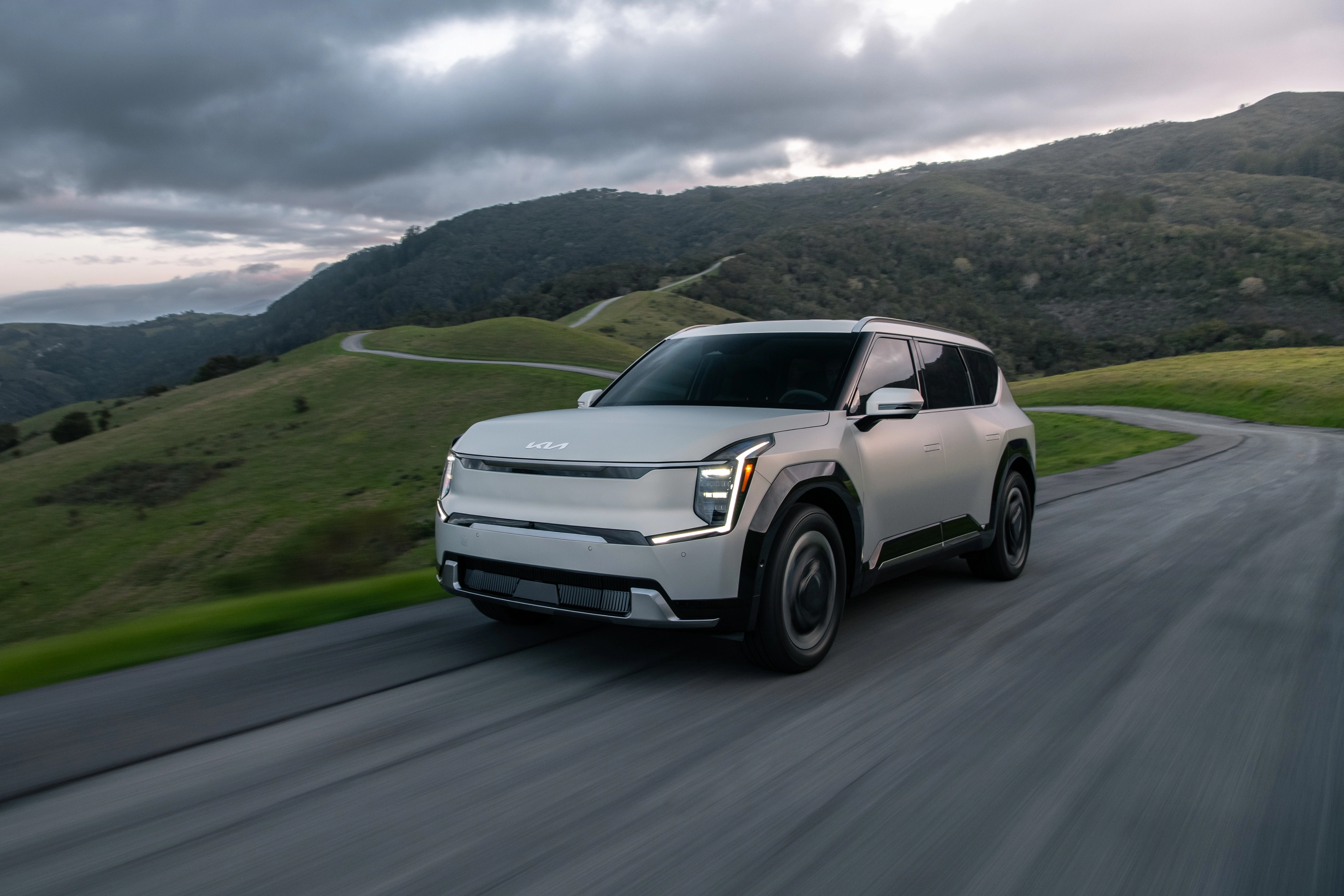
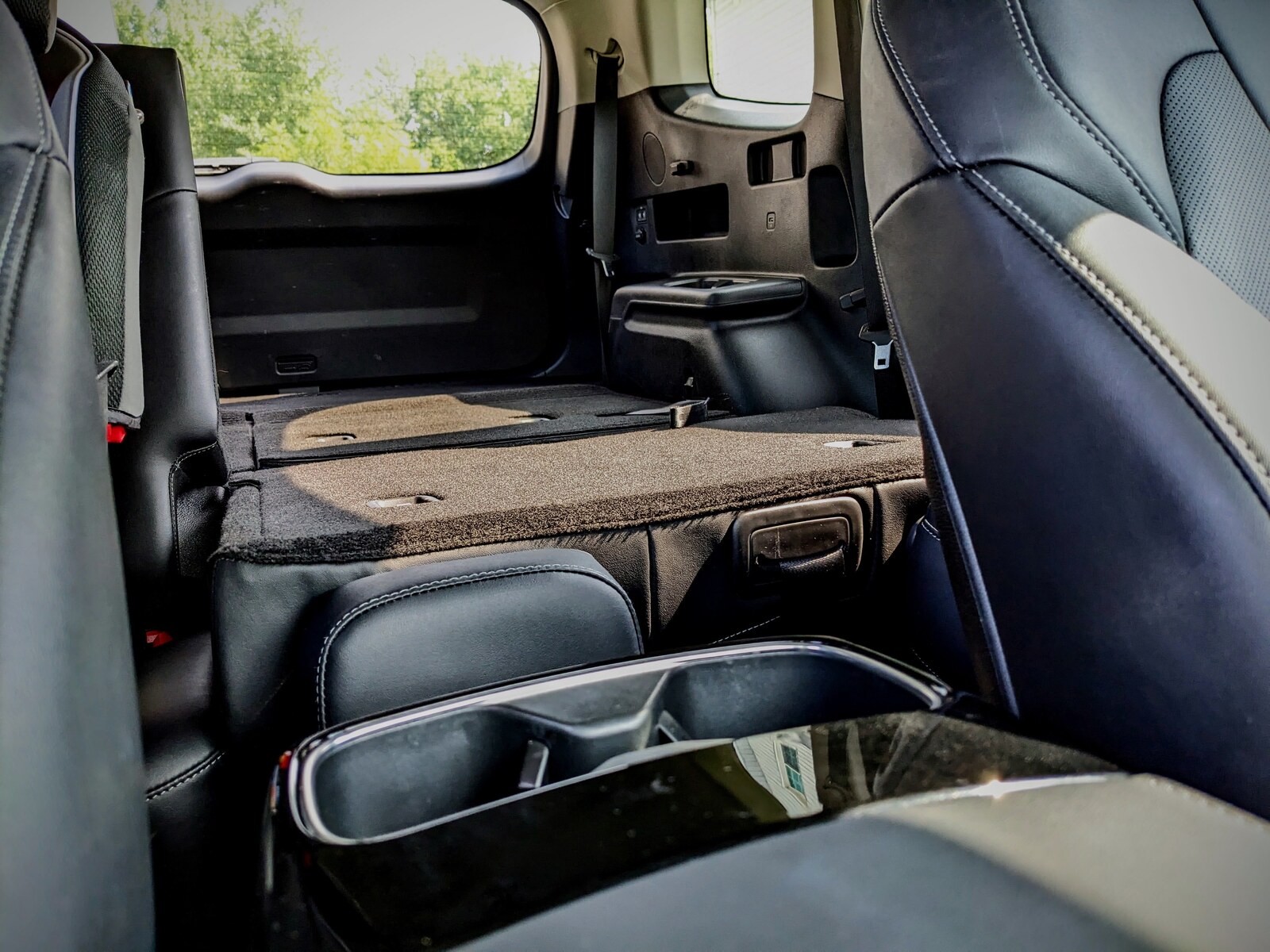
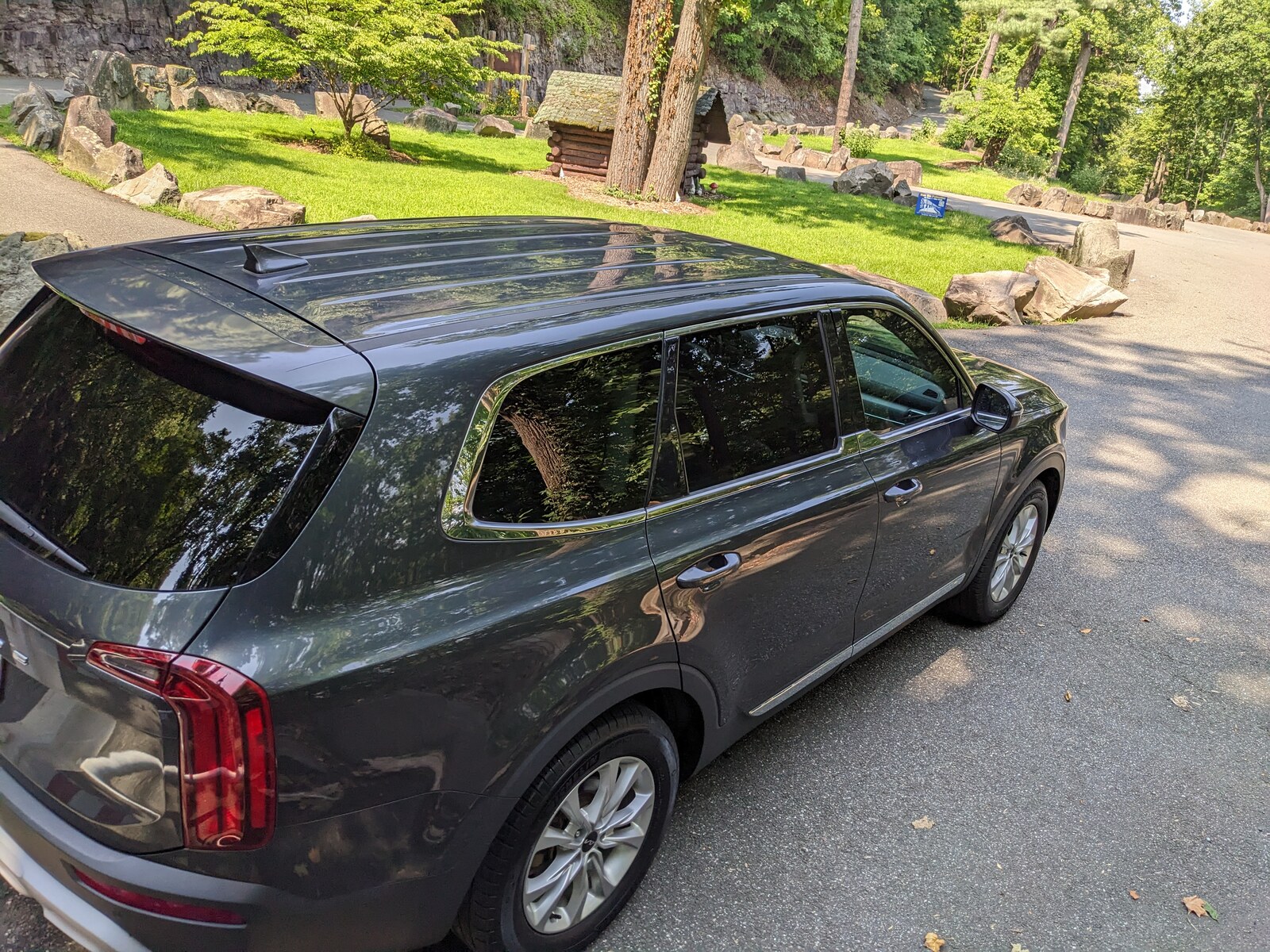
With both rear rows folded, our Kia Telluride opens up to 87 cubic feet — the picture at the top of this post is that exact configuration. That covers a full dorm load with room to breathe, and still seats the driver plus two. If you need to bring the whole family and the load, drop just the third row and you get 46 cubic feet plus five seats, which handles a lighter list.
The floor length with everything folded is the part that matters most: it is what lets a rug, a bookshelf, and a folded drawer cart lie flat instead of standing up and falling over on every turn.
The Load Order (This Is the Whole Trick)
Loading a vehicle is a last-in, first-out problem, and most people load in the order things happen to reach the driveway. Do it deliberately instead:
1. Heavy and low, pushed forward. Mini-fridge, bins of books, anything dense goes on the floor against the back of the seats. Never stack heavy items by the tailgate — it upsets the handling and it all lunges forward the first time you brake hard on the Turnpike.
2. Rigid boxes next, forming a flat platform. Bins with lids are structural. Arrange them into a level surface rather than a pile.
3. Soft goods fill every gap. Bedding, pillows, laundry bags, clothes. These are the mortar between the bricks and they stop everything from rattling for four hours.
4. Flat items along the sides. Rug, mirror, whiteboard, headboard — upright against the side walls, not lying across the top where they slide.
5. Last in: the first-hour box. This is the single best tip in this article. Pack one clearly labeled bin with what you need in the first sixty minutes: bedding, a towel, toiletries, phone chargers, scissors or a box cutter, a power strip, cleaning wipes, trash bags, ibuprofen, and water. It goes in last so it comes out first. Without it, you unpack the entire vehicle in a stairwell looking for a phone charger.
And leave a sightline out the rear window. The camera is good. The window is better. Use both.
Surviving the Unload Line
Big schools run move-in like an airport. Expect an unload zone with a hard time limit — often twenty to thirty minutes — where you empty the vehicle onto the curb, then one person drives to a distant lot while everyone else guards the pile.
So: decide who parks the car before you arrive, not while an orientation volunteer in a neon vest is knocking on your window. Bring your own folding hand truck if you have one — the school's free bins run out within the first hour of every slot, without exception. Move soft goods first, because they are fast and they clear the curb; save the fridge for the trip where you have help.
Wear real shoes. Bring your own water. And accept that the elevator line in any dorm above four floors on move-in day is a form of performance art.
Regional Notes
Rutgers (New Brunswick). Under an hour from Bergen County, but the campus is spread across several distinct areas — confirm which one before you set the GPS, because getting sent from Livingston to Cook is a real detour.
Penn State, Ithaca, Binghamton, Storrs, Amherst. Three to five hours each. These are the ones where you should leave before dawn. You want to hit the unload zone at the start of your window, not the end, and you want to be driving home in daylight.
Boston-area schools. A special category. Narrow streets, permit-only parking, and buildings whose front doors face an alley. Look at the actual street on satellite view before you go, and if your student is in an off-campus apartment, September 1 in Boston is a citywide moving day of legendary awfulness. Plan around it if you possibly can.
The Drive Home
Here is the thing nobody warns you about. You will drive up with a full vehicle and a person, and you will drive home with an empty vehicle and no person, and that empty cargo hold in the rearview is louder than you expect.
Our sincere advice: plan a stop on the way back. A diner, a lake, a state park, anything. Do not just point the car at home and drive four hours in silence. Every parent we have rented to for a drop-off has said some version of the same thing afterward, and the ones who stopped somewhere had a much better day.
Why Rent for This
Move-in day is the textbook case for renting. You need a large SUV for exactly two days a year — drop-off in August and pickup in May — and buying a bigger vehicle to solve a 48-hour problem is expensive arithmetic.
Renting also means you are not putting 600 highway miles and a fridge-shaped dent into your own car, and you get current tires, a clean cargo area, and a vehicle you do not have to vacuum afterward.
The Telluride is $119 a day with insurance and 24/7 roadside assistance included. Book early — the middle two weeks of August are the busiest stretch of our year, for exactly this reason.
Good luck out there. Bring the box cutter.
Follow the Adventure on Instagram
Move-in loads, road-trip shots, and new arrivals to the fleet. Tag us in your drop-off day photos — we love the fully-loaded ones.
Follow @frostyflame_llc
87 Cubic Feet of Peace of Mind
Reserve a three-row SUV for drop-off weekend before the August rush fills the calendar.
View Our Fleet
Permalink: frostyflame.com/blog/college-move-in-day